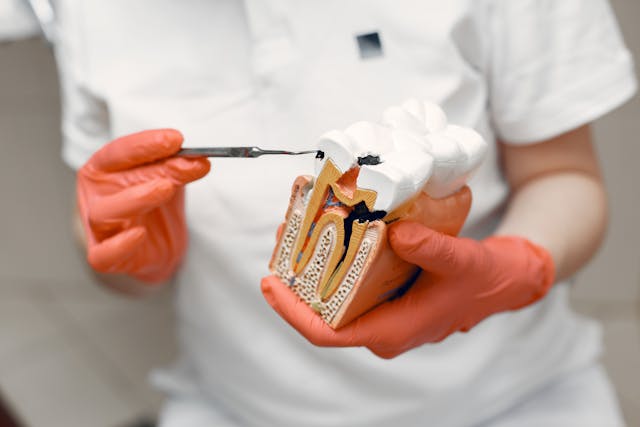
Root canal treatment at Gorgeous Smiles in Melbourne CBD costs between $1,500 and $3,000, depending on which tooth needs treatment and how many canals are involved. A front tooth with one straight canal is a faster, simpler procedure. A back molar with three or four curved canals takes longer, requires more precision, and costs more. The wide price range reflects a straightforward reality: no two teeth are the same, and neither are two infections.
All costs on this page are indicative. Full costs will be discussed with your dentist prior to treatment and may vary based on your individual case.
That price covers the root canal itself but not the dental crown most teeth need afterwards. The crown protects the treated tooth from cracking under chewing pressure, and we break down the full cost (root canal plus crown) in the sections below.
If you're experiencing tooth pain and suspect you need root canal treatment, the best next step is a check-up so your dentist can confirm what's needed and give you exact costs before any work begins.
Root Canal Pricing at Gorgeous Smiles
Here's what root canal treatment costs at our Melbourne CBD dental practice, broken down by tooth type.
All costs are indicative. Full costs will be discussed prior to treatment.
| Treatment | Price |
|---|
| Root canal, front tooth (1 canal) | $1,500 to $1,850 |
| Root canal, premolar (1 to 2 canals) | $1,850 to $2,000 |
| Root canal, molar (3 to 4 canals) | $2,000 to $3,000 |
| Dental crown (post-treatment) | $2,500 |
| Comprehensive examination | $95 |
Root canal pricing at Gorgeous Smiles covers the full treatment including X-rays, local anaesthetic, all required visits, internal medication placed between appointments, and the temporary filling. The final permanent restoration is priced separately because the type of restoration depends on how much tooth structure remains after treatment. Your dentist will discuss the recommended restoration and its cost as part of your treatment plan.
Why Root Canal Costs Vary
Tooth Type and Location
Front teeth have a single, straight canal. The root canal procedure is faster, access is easier, and the fee reflects that. Premolars have one or two canals. Molars have three or four, often curved, and sit at the back of the mouth where visibility and access are limited. More canals means more time cleaning and shaping the root canal system, which drives the overall cost up.
If your dentist has identified a front tooth, you're at the lower end of the range. If it's a back molar, expect the higher end.
Complexity of the Infection
A tooth caught early, where the infected tooth pulp hasn't spread far into the canal system, is a more straightforward case. If the infection has been present for weeks or months, the canals may be harder to clean thoroughly. The affected tooth may need additional medication placed inside between visits, which extends the treatment timeline and affects the associated costs.
Number of Appointments
Most root canals at Gorgeous Smiles are completed in 2 to 5 visits depending on the complexity of the case. A simple front tooth root canal procedure may be finished in fewer sittings. A complex molar with deep decay and multiple canals may require additional follow-up visits with inter-appointment medication to clear the infection before the canals are permanently sealed.
Technology
Gorgeous Smiles uses rotary endodontics and digital X-rays throughout the root canal process. Rotary instruments are designed to clean and shape the canals with precision.
Retreatment
If you're having a previous root canal redone because the original treatment failed or a new infection developed, the procedure is more involved. The dentist needs to remove old filling material from inside the canals and re-access the root canal system. Retreatment costs more than a first-time procedure and will be confirmed at your initial consultation.
Complex Cases
Gorgeous Smiles treats the majority of root canals in-house. Cases involving severely curved or calcified canals, or retreatments with unusual root canal anatomy, may be referred to a specialist endodontist. Specialists charge more than a general dentist for the same root canal treatment, reflecting additional postgraduate training. Your dentist will tell you upfront if a referral is recommended.
What's the Total Cost Including a Crown?
The root canal pricing above covers the treatment itself, not the restoration that follows. Here's the full budget picture.
Why You'll Probably Need a Crown
After a root canal, the treated tooth has lost its nerve and blood supply. Over time this makes the tooth more brittle and more likely to crack under normal chewing pressure. For premolars and molars, a dental crown is almost always recommended to protect the tooth long-term. For front teeth, a dental filling may be sufficient if enough natural tooth structure remains, since front teeth bear less biting force.
Worked Total-Cost Examples
All costs are indicative. Full costs will be discussed prior to treatment.
Front tooth root canal plus filling: $1,500 to $1,850 for the root canal, plus $220 to $495 for a filling. Approximate total of $1,720 to $2,345.
Premolar root canal plus crown: $1,850 to $2,000 for the root canal, plus $2,500 for the crown. Approximate total of $4,350 to $4,500.
Molar root canal plus crown: $2,000 to $3,000 for the root canal, plus $2,500 for the crown. Approximate total of $4,500 to $5,500.
Crown pricing should be confirmed at your consultation. These figures give you a budget range for planning purposes.
Root Canal vs Extraction: What's the Cost Comparison?
At first glance, a tooth extraction looks like the less expensive option. An extraction at Gorgeous Smiles costs $300 to $700. A root canal plus crown runs $4,500 to $5,500 for a premolar or molar.
However, a missing tooth may lead to other issues over time. Without the tooth, the adjacent teeth may shift into the gap. Bite changes can occur. Bone loss may begin in the area where the root used to be. Many patients end up needing a tooth replacement, and that's where the cost increases.
Tooth Replacement Options After Extraction
All costs are indicative. Full costs will be discussed prior to treatment.
Dental implant plus crown: $4,500 to $5,550. Treatment timeline of 3 to 6 months, surgical procedure. Published clinical data indicates implant posts can last 25 years or more in many cases, though this is not guaranteed.
Dental bridge: $6,500 to $7,500. Requires preparing the surrounding teeth on either side of the gap to support the bridge.
Removable partial denture: $500 to $2,000. The most affordable option, but removable and needs replacing every 5 to 10 years.
Comparing Costs
Root canal plus crown: $4,500 to $5,500. One treatment, preserves your natural tooth.
Extraction plus implant: $4,800 to $6,250 total. Longer timeline, surgical procedure.
Extraction plus bridge: $6,800 to $8,200 total. Faster than an implant but requires preparing the adjacent teeth.
Extraction plus denture: $800 to $2,700 total. Least expensive path, but needs periodic replacement.
In many cases, root canal treatment is comparable in cost to extraction followed by tooth replacement, while preserving the natural tooth. The only situation where extraction may be more appropriate is when the tooth is too damaged or the infection too severe to predictably restore. Your dentist will advise you directly if that's the case.
When to Choose a Root Canal vs Extraction
A root canal may be appropriate when the tooth can be saved, the infected or inflamed pulp is contained but the surrounding tooth structure is still strong, and keeping your natural tooth is clinically indicated.
Extraction may be appropriate when the tooth is too damaged (badly cracked, very little tooth structure remaining), severe bone loss makes it non-restorable, or saving it would not be clinically viable. Your dentist will assess your individual situation and recommend the appropriate treatment at your consultation.
Risks of Root Canal Treatment
All dental treatments carry risks. Risks of root canal treatment include post-operative pain and swelling, which can range from mild to significant depending on the complexity of the case and the presence of pre-existing infection; infection that persists or recurs despite treatment; perforation of the root during cleaning or shaping of the canals; separated instruments within the canal; incomplete cleaning of the canal system, particularly in teeth with complex or curved canal anatomy; damage to surrounding teeth or dental work; and the possibility that the tooth may still need extraction if treatment is unsuccessful. The treated tooth may also become more brittle over time and is at increased risk of fracture, which is why a crown is recommended for most teeth after root canal treatment.
Your dentist will discuss all risks specific to your case before proceeding.
For full information about risks and potential side effects, please visit our treatment risks page: https://www.gorgeoussmiles.com.au/treatment-risks/
How Long Does a Root Canal Last?
Published clinical data indicates root canal treatment has a success rate above 95% over 10 years. With a proper dental crown and good oral care, treated teeth can last 10 to 20 years or more. However, longevity is not guaranteed and depends on individual factors including oral hygiene, the complexity of the original case, and whether complications arise.
In rare cases, reinfection can occur if the crown seal is compromised, a canal was missed during the original treatment, or a crack develops in the remaining tooth structure. Retreatment or a minor surgical procedure called an apicoectomy can resolve the problem in many cases. Regular dental check-ups allow your dentist to identify issues early.
Good oral hygiene around the treated tooth, regular dental check-ups, avoiding biting down hard directly on the crown, and wearing a night guard if you grind your teeth all contribute to supporting the longevity of the restoration.
Does Health Insurance Cover Root Canal Treatment?
Root canal therapy is classified as endodontic treatment under "Major Dental" in most private health insurance extras policies. Not all policies include Major Dental cover, so the first thing to check is whether your specific health fund plan covers it at all.
If your policy does include Major Dental, most funds cap annual benefits at $1,000 to $2,000. On a $2,000 root canal, the annual cap (not the rebate percentage) is often the binding constraint on your out of pocket expenses. Crown coverage falls under the same Major Dental category. If both the root canal and crown are completed in the same benefit year, you may hit your annual limit before the crown is fully covered. Some patients choose to stage the root canal and crown across two calendar years to access two separate annual allocations — check with your health fund whether this approach works with your policy.
Waiting periods for Major Dental are typically 12 months. If your policy is recent, check whether that period has passed before booking. Medicare does not cover root canal treatment.
Before your appointment, ask your dental provider for a written treatment plan with item numbers and submit it to your health fund for a pre-treatment estimate. You'll know your out of pocket cost before committing to anything.
Payment Plans for Root Canal Treatment
Gorgeous Smiles offers interest free payment plans through AfterPay, Humm, and Zip. A $5,000 root canal plus crown treatment spread over 12 months works out to approximately $96 per week. Over 24 months, that drops to around $48 per week. Repayments can be structured weekly, fortnightly, or monthly.
If you're experiencing pain or have been diagnosed with a tooth infection, speak to the team about your treatment plan and payment options at your appointment. Untreated tooth infections can progress and may lead to more complex treatment requirements over time.
All costs are indicative. Full costs will be discussed prior to treatment.
Book Your Root Canal Appointment
If you're experiencing tooth pain, sensitivity to hot or cold, tooth swelling, or significant pain around a tooth, a comprehensive examination will confirm whether you need a root canal. Your dentist will provide a full treatment plan with costs and discuss all risks involved before any work begins. Emergency dental care is available for urgent cases.
For full information about treatment risks, please visit: https://www.gorgeoussmiles.com.au/treatment-risks/
Gorgeous Smiles Melbourne CBD | 121 Exhibition St | Book online or call (03) 9042 0483
FAQs About Root Canal Costs in Melbourne
Is a root canal painful?
Modern root canal treatment is performed under local anaesthetic, which is designed to prevent pain during the procedure, though you may feel pressure. In cases of acute infection, anaesthesia may be less effective, and your dentist will manage this during the appointment. Post-operative discomfort varies depending on the complexity of the case — simple front tooth cases may involve mild soreness for a few days, while complex molar treatments with pre-existing infection may involve more significant discomfort. Your dentist may prescribe stronger pain relief for complex cases.
How many appointments does a root canal take?
Most root canals at Gorgeous Smiles require 2 to 5 appointments depending on the complexity of the case. Simple front tooth cases may be resolved in fewer visits. Molars with deep decay, multiple canals, or significant infection may need additional follow-up visits with medication placed inside the tooth between sessions.
Do I definitely need a crown after a root canal?
For premolars and molars, yes, in almost all cases. A dental crown protects the treated tooth from cracking under chewing pressure. For front teeth, a dental filling may be sufficient if enough natural tooth structure remains. Your dentist will recommend the most appropriate restoration and include the cost in your treatment plan.
Can a root canal fail?
Published data indicates root canal treatment has a success rate above 95% over 10 years. However, reinfection can occur, particularly if the crown seal is compromised, a canal was missed during the original treatment, or a crack develops in the tooth. Retreatment or a minor surgical procedure called an apicoectomy can resolve the problem in many cases. Your dentist will discuss the risks specific to your case before treatment.
Is it cheaper to just pull the tooth?
The extraction itself is less expensive ($300 to $700 compared to $1,500 to $3,000 for a root canal). But if you then need to replace the missing tooth with a dental implant ($4,500 to $5,550) or dental bridge ($6,500 to $7,500), the total cost of extraction plus replacement may be higher than saving the tooth with a root canal and crown. Your dentist will discuss the options, costs, and risks at your consultation.
Does Gorgeous Smiles refer complex root canals to a specialist?
Complex cases involving severely curved or calcified canals may be referred to a specialist endodontist. Your dentist will identify this at your initial consultation and explain the referral, the additional costs involved, and what to expect.
How quickly can I be seen if I'm in pain?
Gorgeous Smiles offers emergency dental care for urgent tooth pain. Call (03) 9042 0483 and let the team know you need emergency care. They'll prioritise getting you seen as soon as possible.