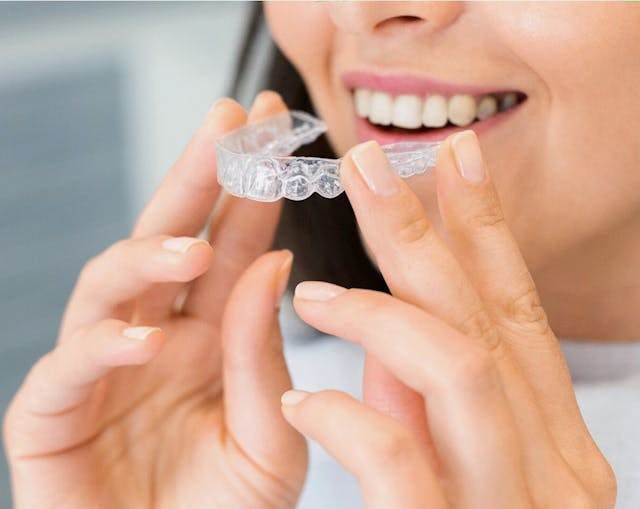
Invisalign offers several treatment tiers designed for different levels of orthodontic complexity. If you're considering Invisalign, understanding the differences between Lite, Moderate, and Full can help you discuss the right option with your dentist. This page compares the three tiers across treatment approach, duration, technology, cost, aftercare, and risks.
All costs on this page are indicative. Full costs will be discussed with your dentist prior to treatment and may vary based on your individual case.
Invisalign Lite vs Moderate vs Full: Treatment Approach
All Invisalign treatment tiers follow a similar process: consultation, treatment planning, aligner wear, regular check-ups, and retention. The key difference is the number of aligners used and the scope of issues each tier can address.
Invisalign Lite treatment approach
Invisalign Lite is designed for minor orthodontic issues.
Consultation: Your dentist determines whether Invisalign Lite is appropriate for your case. X-rays and impressions are taken to create a 3D model of your teeth.
Treatment plan: A customised treatment plan is created. You can ask questions and your dentist will explain the process.
Begin treatment: When your aligners arrive, they are fitted at a second appointment. Your dentist shows you how to insert and change them. Aligners are typically worn for 20 to 22 hours per day.
Regular check-ups: Every six weeks, your dentist assesses progress and carries out any routine dental work.
Invisalign Moderate treatment approach
Invisalign Moderate is designed for moderate orthodontic issues, such as bite correction.
Initial consultation: Your dentist assesses your teeth and determines suitability. Scans and impressions are taken to create a 3D model.
Customised treatment plan: A treatment plan is created based on the 3D model. You can ask questions and learn about the process.
Use your aligners: Aligners are worn for 20 to 22 hours per day, gradually moving teeth into the planned position.
Regular check-ups: Every six weeks to assess progress and make any adjustments.
Invisalign Full treatment approach
Invisalign Full is designed for more extensive alignment and bite correction.
Initial consultation: Your dentist examines your teeth, takes X-rays, and creates a 3D digital model.
Treatment plan: A detailed plan outlines the planned tooth movements. Your dentist discusses the plan and answers questions.
Start treatment: Aligners are worn for two weeks at a time, typically 20 to 22 hours per day, removing only to eat, drink, and brush.
Monitor progress: Regular appointments allow your dentist to check that teeth are moving as planned and make adjustments where needed.
Invisalign Lite vs Moderate vs Full: Treatment Duration
Invisalign Lite: Typically a few weeks to six months, depending on the amount of tooth movement required. Designed for minor alignment issues only.
Invisalign Moderate: Typically six months to one year. Duration varies depending on the issues being addressed.
Invisalign Full: Typically nine to eighteen months, with some cases taking up to 24 months. Designed for more complex bite or alignment issues.
Your dentist will provide an estimated timeframe at your consultation. Treatment plans must be followed consistently for these timeframes to be accurate.
Invisalign Lite vs Moderate vs Full: Technological Features
All Invisalign tiers use the same core technology:
SmartForce Attachments: Features such as precision cuts, power ridges, and bite ramps to assist tooth movement.
SmartStage Technology: Programmes sequential tooth movements to support treatment planning.
SmartTrack Material: Applies gentle, constant force to move teeth.
Invisalign Lite vs Moderate vs Full: Cost
All costs are indicative. Full costs will be discussed prior to treatment.
Invisalign Lite: Starts from $6,000. Cost varies depending on the amount of work required. Your dentist will provide a specific price at your consultation.
Invisalign Moderate: Starts from $7,500. Cost depends on the number of teeth being moved and what issues are being addressed.
Invisalign Full: Starts from $8,500. Cost varies depending on the complexity of bite or alignment issues.
Payment plans are available through AfterPay, Humm, and Zip with interest-free options across up to two years.
Invisalign Lite vs Moderate vs Full: Clinical Support
All Invisalign treatments at Gorgeous Smiles include regular in-person support. Check-ups occur every six weeks, where your dentist monitors progress, makes adjustments, and carries out routine dental work including cleaning and decay checks. Support is also available via phone and email.
Invisalign Lite vs Moderate vs Full: Aftercare
The aftercare process is the same regardless of the tier you choose. Key requirements:
Wear your retainer every night to maintain tooth position — without retainer wear, teeth may shift back toward their original position.
Rinse your aligners after every use.
Avoid toothpaste on your aligners, as this can scratch them.
Brush and floss regularly to maintain oral hygiene.
Attend dental appointments every six months.
Be aware that staining foods and drinks (coffee, wine, berries) may affect tooth colour.
Risks of Invisalign Treatment
All orthodontic treatments carry risks. Risks of Invisalign treatment (across all tiers) include discomfort and pressure when new aligners are placed, particularly in the first few days of each new tray; tooth root resorption (shortening of the tooth roots); enamel wear at attachment sites; gum irritation from aligner edges; temporary speech changes; the possibility that treatment may take longer than estimated or may not fully achieve the planned outcome; and relapse (teeth shifting back) if retainers are not worn as directed. Your dentist will discuss all risks specific to your case before treatment begins.
For full information about risks and potential side effects, please visit our treatment risks page: https://www.gorgeoussmiles.com.au/treatment-risks/
Book an Invisalign Consultation
If you're considering Invisalign, a consultation is the appropriate starting point. Your dentist will assess your teeth, discuss which tier is clinically appropriate for your case, provide a treatment plan with costs, and discuss all risks involved. There is no obligation.
For full information about treatment risks, please visit: https://www.gorgeoussmiles.com.au/treatment-risks/
Gorgeous Smiles Melbourne CBD | 121 Exhibition St | Book online or call (03) 9042 0483
Common Concerns We Help Address with Invisalign Treatment
Can Invisalign help with an overbite, Can Invisalign correct an underbite, Can Invisalign rotate teeth, Can Invisalign close gaps, Can Invisalign address an open bite, Can Invisalign address a crossbite, Can Invisalign address crowded teeth, Can Invisalign address crooked teeth, Can Invisalign be used for bottom teeth only, Can Invisalign be used for top teeth only.
More Information About Invisalign Treatment
Does Invisalign hurt, How long does Invisalign take to work, Invisalign vs veneers, Am I a candidate for Invisalign.