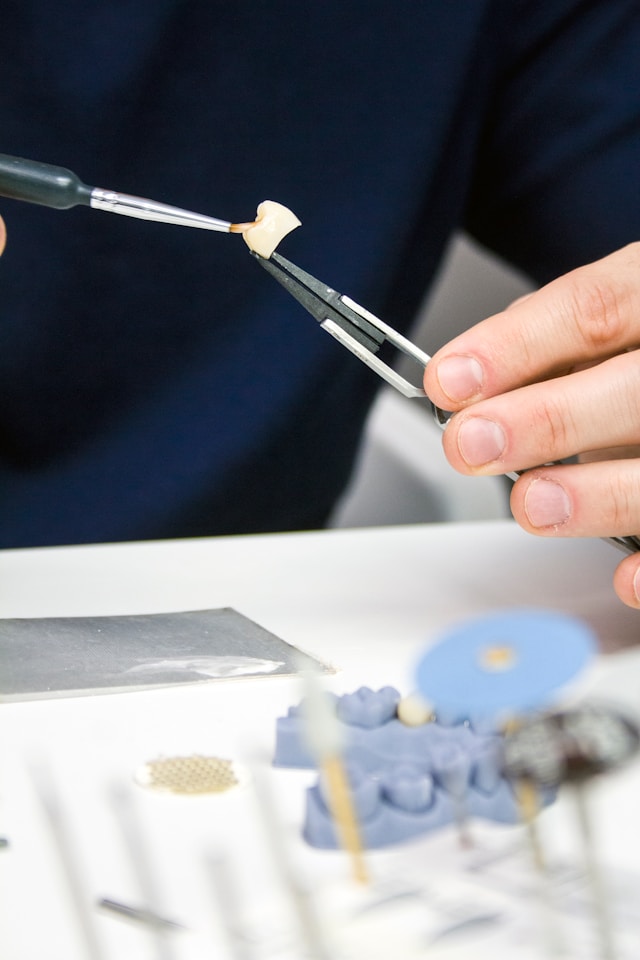
A dental crown is a custom-made crown that fits over a damaged or weakened tooth to restore its strength and protect what is left of it. At Gorgeous Smiles, our AHPRA-registered dentists fit crowns at our Melbourne CBD clinic on Exhibition Street, using tooth-coloured materials matched to the teeth around them. Whether a crown is right for your tooth is something an assessment confirms. To get started, book an appointment with our dental team.
A crown caps the whole visible part of a tooth above the gum line, rather than filling in one section of it. That is the difference between a crown and a filling: a filling repairs part of a tooth, while a crown covers a tooth that has lost too much structure for a filling alone. Once bonded into place it is fixed, not removable like a denture, and a crowned tooth is cared for much like your natural teeth. It shields the underlying tooth structure from further damage and restores function so you can bite and chew normally. It is also colour-matched to your existing teeth, so it blends in.
A dentist only recommends a crown after examining the tooth, but the common reasons point to a damaged or weakened tooth that needs more than a smaller repair: a cracked or broken tooth, a fractured or heavily filled tooth where a large filling has been replaced repeatedly, a tooth left more brittle after root canal treatment, worn teeth where grinding has thinned the biting surface, and a tooth too damaged for a filling to hold, where a crown protects what remains and the surrounding teeth. Booking an assessment confirms whether a crown suits your tooth.
A crown isn't always the answer. The deciding factor is usually how much healthy tooth is left, because a crown needs enough sound tooth structure underneath to support the cap. Where there is too little, or insufficient dental enamel to hold one well, another approach may suit better. If only a small part of the tooth is affected, a filling or some bonding with composite resin can often restore it without the tooth preparation a crown involves. For a front tooth where the concern is mainly how it looks, porcelain veneers may be more conservative, and where a tooth is already missing, a dental bridge or a dental implant replaces the gap instead. Fitting a crown also reshapes the tooth and removes enamel that won't grow back, so it isn't a step to take if a smaller repair would do.
A crown usually takes two appointments a couple of weeks apart, because it is custom made for your tooth at a dental laboratory in between.
The dentist examines the tooth and takes X-rays or a scan to check it and the bone around it. Any decay or old filling is removed, and the tooth is shaped so the crown will sit over it correctly. This tooth preparation is carried out under local anaesthetic. An impression or scan of the prepared tooth then goes to the dental laboratory, and a temporary crown protects the tooth until the next visit.
The temporary crown comes off and the dentist checks the permanent crown against the tooth before fixing it, looking at how it fits and how it meets your other teeth when you bite. Once the fit and bite are confirmed, the crown is bonded onto the prepared tooth, and this crown placement is the final step.
As with any dental procedure, there are risks, including sensitivity, the need for further treatment such as root canal treatment if the nerve is affected, and, rarely, a crown that doesn't settle and needs adjusting or remaking. The dentist will talk you through what to expect at your appointment. In some cases, Gorgeous Smiles offers same-day crown treatment using digital scanning and in-house CAD/CAM technology, allowing certain crowns to be designed and fabricated during a single visit where clinically appropriate. If same-day fabrication isn't suitable, a temporary crown may be placed while the permanent crown is made.
Crowns are made from a few materials, and the right one depends mainly on where the tooth sits. Porcelain crowns and ceramic crowns look the most like natural enamel, which mak es them a common choice for front teeth and other visible teeth. Zirconia crowns are tooth-coloured but considerably stronger, so they hold up well on back teeth and for people who grind. Porcelain-fused-to-metal, full metal and gold crowns are very hard-wearing and suit molars at the back. There is no single best crown material; the dentist weighs up where the tooth sits and the force it takes when you chew.
With proper care, a crown commonly lasts around ten to fifteen years, and often longer. How long yours lasts depends on where it sits and how heavily it is used, so treat that as a guide rather than a promise. Caring for a new dental crown comes down to good oral hygiene, much like the rest of your teeth: brush twice a day and floss around the margin where the crown meets the gum, since that join is where decay can creep in underneath. Regular dental check ups let the dentist spot wear early, and a night guard helps if you grind at night.
There is no flat price, because a few things change what a crown costs. The crown material, for example, since a porcelain or zirconia crown isn't priced the same as a metal one. So does the tooth: a straightforward crown is a smaller job than one needing a build-up or root canal treatment first. At Gorgeous Smiles, dental crowns generally range from $1,000 to $2,500 per tooth, depending on the material selected.
The quoted price typically includes tooth preparation, custom crown fabrication and permanent fitting, though additional costs may apply for consultations, imaging, temporary crowns and any preparatory treatment required. We give you a personalised quote after the dentist has assessed your tooth, so you know the cost of your dental treatment up front. Interest-free payment plans are available through Afterpay, Humm and Zip, with payment terms ranging from 1 to 24 months (subject to eligibility criteria and terms and conditions).


Our Melbourne CBD dental clinic at 121 Exhibition Street is within a:
For public transport options, download the PTV app or visit the Public Transport Victoria website.
A crown can restore a damaged tooth's strength and protect what is left of it, and for a suitable tooth it can be a long-term option that avoids extraction. Whether it is the right step, or whether something more conservative fits better, comes down to an assessment. Book an appointment at our Melbourne CBD clinic and the dentist will examine the tooth and talk through your options before giving you a quote. Call (03) 9042 0483 or book online to arrange a time.
It depends on the crown material and any work the tooth needs first. We give a personalised quote once the dentist has examined the tooth, and interest-free payment plans are available (subject to terms and conditions).
Most crowns take two appointments a couple of weeks apart. The first covers tooth preparation and a temporary crown, and the second is when the permanent crown is fitted.
Tooth preparation is carried out under local anaesthetic, so you shouldn't feel pain during the appointment, though you may notice pressure. Mild sensitivity for a few days afterwards is common and usually settles on its own.
With good care, a crown commonly lasts around ten to fifteen years, and often longer. How long yours lasts depends on where the tooth sits and how heavily it is used, so the range is a guide rather than a guarantee.
A crown is colour-matched to your surrounding teeth when it is made. It won't respond to whitening afterwards, because the material doesn't lighten the way natural teeth do, so whitening is best done beforehand.
A crown covers and restores a single damaged tooth. A dental bridge replaces a tooth that is already missing by joining to the teeth on either side to hold a false tooth in the gap.
Yes. Interest-free payment plans are available so the cost can be spread out (subject to terms and conditions).