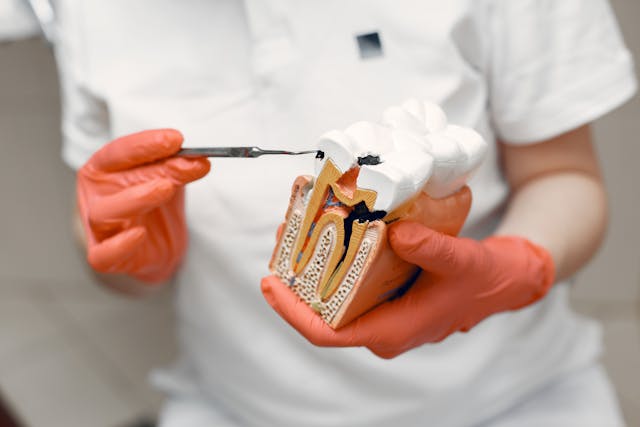
Gorgeous Smiles provides root canal treatment in Melbourne to relieve the pain of an infected or damaged tooth and save it from extraction. Many people are nervous about root canal treatment, but the procedure is routine and carried out under local anaesthetic, so the tooth is fully numbed throughout, and for most people it relieves the pain they walked in with. If you're dealing with a tooth that's aching or sensitive, you can book an appointment to have it assessed.
Pain is usually the first symptom, and it tends to have a particular character. Lingering sensitivity is common: a tooth that stays sore for a minute or two after something hot or cold, rather than settling straight away, often points to trouble in the dental pulp at the centre of the tooth. A deep, throbbing ache that won't ease, or sharp pain when you bite down, can mean the same thing.
The signs aren't always painful. A tooth can darken compared with the ones beside it as the pulp inside it dies. You might also notice swelling or tenderness in the nearby gums, sometimes with a small pimple-like spot that can point to an abscess. Together these suggest an infection has reached the tooth pulp, where the nerve and blood supply sit.
These symptoms rarely fade on their own. An infected tooth tends to get worse the longer it's left, so it's worth having it assessed quickly rather than waiting to see if it settles.
The aim is straightforward: remove the infection from inside the tooth and seal it so bacteria can't get back in. Despite its reputation, the root canal procedure follows a routine set of steps.
Your dentist starts by numbing the tooth with local anaesthetic, so you don't feel the work itself. The tooth is then isolated with a dental dam, a thin sheet that keeps it clean and dry while treatment is carried out. An X-ray helps map the inside of the tooth before anything begins.
From there, the dentist opens the top of the tooth and removes the infected pulp, the soft tissue that holds the nerve and blood supply. The narrow canals inside the roots are cleaned and shaped, then filled with a rubber-like material called gutta percha and sealed. A temporary filling often closes the tooth while it settles.
Because a treated tooth can become brittle, it usually needs a permanent restoration afterwards, either a permanent filling or, more often, a crown to protect it and return normal function. Most root canal treatment is finished in one or two visits, depending on the tooth and how much infection is present.
Concerns about pain are common and understandable. In practice, the procedure itself is carried out under local anaesthetic. With the tooth fully numbed under local anaesthetic, most patients report little discomfort during the appointment itself. The ache that brings people in is caused by the infection inside the tooth, and the aim of the treatment is to clear that infection and resolve the underlying pain.
Afterwards, it's normal to feel some tenderness or mild discomfort around the tooth for a day or two, which most people manage with over-the-counter pain relief. Most are back to their usual routine the next day. Comfort and recovery do vary from one person to the next, which is why your dentist talks you through what to expect, including any aftercare for your tooth.
A few things drive the cost, and they're worth understanding before you assume a figure you've seen elsewhere applies to you. It depends on the tooth and the number of canals. See our root canal cost page. The biggest factor is which tooth needs treatment. A front tooth has a single canal and is more straightforward, while a molar at the back has several canals and takes longer to treat. How involved the infection is matters too, as does whether the tooth needs a crown afterwards to protect it.
Because of that, Gorgeous Smiles gives you a clear written quote before any treatment begins, once the dentist has examined the tooth and taken an X-ray. You'll know what's involved and what it costs before you decide to go ahead.
Medicare doesn't cover routine root canal treatment. Most private health funds with dental extras pay a rebate, so it's worth checking your level of cover with your fund.
When a tooth is badly infected, the choice usually comes down to two options: saving it with a root canal, or a tooth extraction. Where the tooth can be saved, keeping it is generally better. A root canal keeps your natural tooth in place, which preserves your bite and the way your teeth meet.
The alternative is tooth extraction, removing the tooth, leaves a gap that often needs filling later with a dental implant or a dental bridge. That's more involved, and more costly over time, than treating the tooth you already have.
Extraction is sometimes the only sensible choice. If a tooth is too fractured or too damaged at the roots to restore, taking it out may be the better option. Which path suits your tooth is something the dentist works out at your appointment, after examining it and reviewing an X-ray.


Our Melbourne CBD dental clinic at 121 Exhibition Street is within a:
For detailed information about public transport options, download the PTV app or visit the Public Transport Victoria website.
The first step is to have the tooth looked at, so a dentist can confirm whether a root canal will save it and settle the pain. Booking an assessment is also the point where you'll get your written quote, before any treatment goes ahead.
Gorgeous Smiles is a dental practice in the heart of the Melbourne CBD at 121 Exhibition Street, with AHPRA-registered dentists and an easy walk from public transport across the city. If you're in pain or think you might need a root canal, call (03) 9042 0483 or book online to arrange a time.
It depends on the tooth. A front tooth with a single canal is quicker than a back molar with several. Many cases are done in one appointment, with more complex teeth spread over two visits.
Often one or two. Straightforward cases can be finished in a single visit, while a tooth with a stubborn infection may need a second so the canals settle fully before they're sealed.
No. Medicare doesn't cover routine dental treatment, including root canals. If you hold private health insurance with dental extras, your fund may pay a rebate, so it's worth checking your level of cover.
A treated tooth can last many years, sometimes a lifetime, when it's restored properly and cared for. A crown helps protect it from fracture. Results vary from tooth to tooth, and regular check-ups make a difference.
Not every tooth. Most teeth with an infected pulp can be saved, but one that's badly fractured or too broken down may not be restorable, in which case extraction is the safer choice. The dentist assesses this at your appointment.
Often, especially for back teeth that take the force of chewing. A root canal can leave a tooth more brittle, and a dental crown protects it from cracking. Some front teeth can be restored with a filling instead.
The infection doesn't clear on its own and tends to spread, bringing worsening pain and the risk of a dental abscess, along with damage to the bone around the tooth. The longer it's left, the more likely the tooth is lost rather than saved, so early assessment gives you the best chance of keeping it.