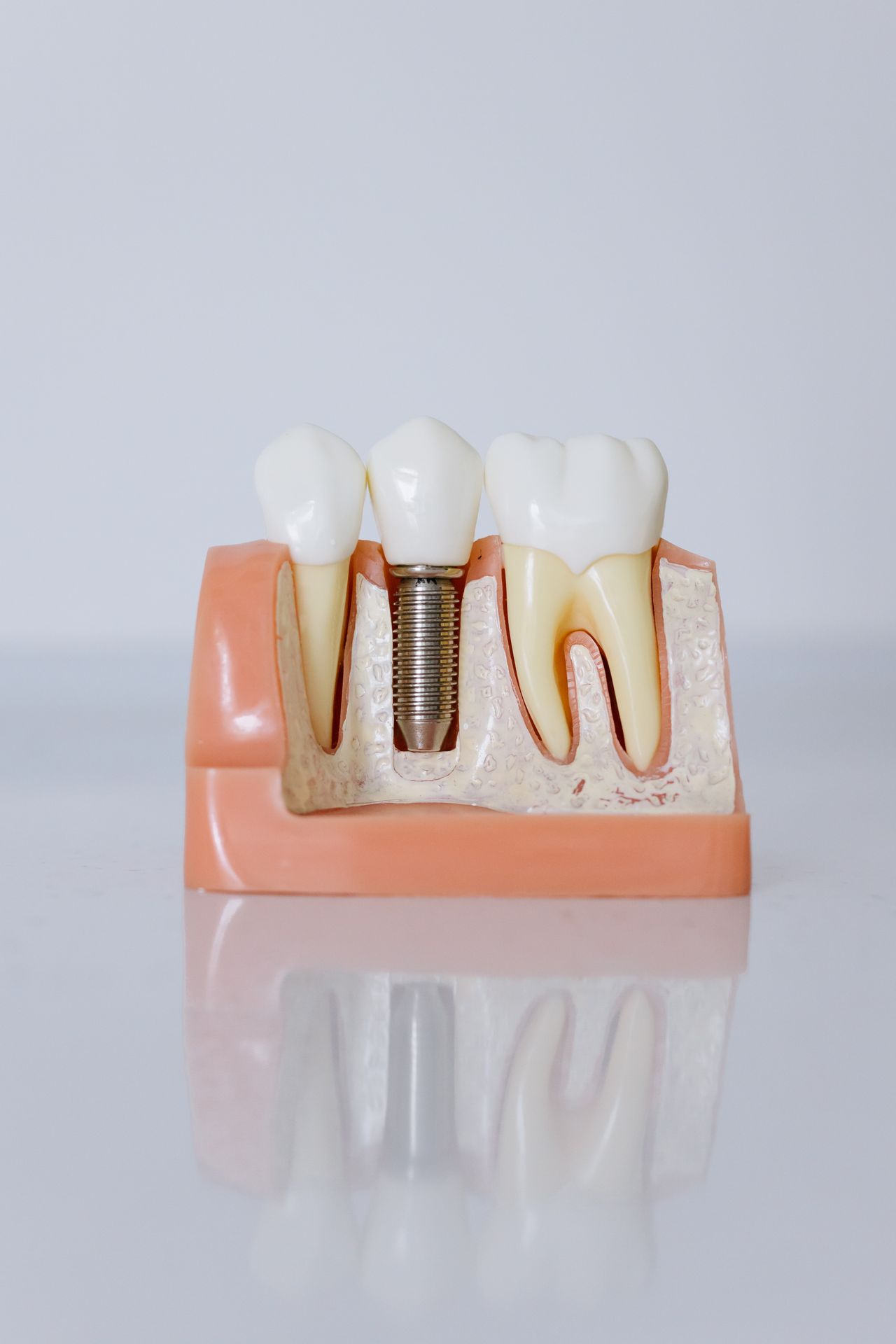
A single dental implant replaces one missing tooth from the root up, using a titanium post set into the jaw and a custom crown fitted on top. It fills the gap on its own, without relying on the teeth either side, which is the main thing that separates it from a bridge. At Gorgeous Smiles, single dental implants in Melbourne are placed by AHPRA-registered dentists at our clinic on Exhibition Street in the CBD, after an assessment that confirms whether an implant is the right option for your tooth. If you're weighing up how to deal with a single missing tooth, you can book a consultation to check your suitability.
Unlike a crown or a filling, an implant replaces the part of the tooth you can't see as well as the part you can. A small titanium post is placed into the jawbone, where it acts as an artificial tooth root. Over the following months it fuses with the surrounding bone, a process called osseointegration, and that bond is what gives the replacement a stable footing.
Once the post has integrated, a custom crown is fitted on top, shaped and shaded to sit in with your natural teeth. The finished result is a standalone replacement tooth that doesn't lean on the teeth around it. Because the implant anchors into the jaw bone rather than the adjacent teeth, those neighbouring teeth are left untouched, which is the practical difference between dental implants and dental bridges.
A single implant is designed for one gap. If you're replacing multiple teeth, there are other approaches such as implant-supported bridges or implant-retained dentures, and your dentist can talk through those at an assessment.
Most adults missing a single tooth, with enough bone in the jaw to hold an implant and reasonably healthy gums, are good candidates. Whether you fit that picture is something an exam and a scan confirm, not a website.
Some people need a bit of preparation first. Where the jaw has lost bone after a tooth has been missing for a while, bone grafting can build the site back up so it can support an implant. Gum disease or active decay usually needs treating before any implant work begins, because the long-term success of an implant rests on healthy gum tissue and bone around it. If you grind your teeth heavily or have a health condition that affects healing, that factors in too.
We'll tell you honestly if an implant isn't the right call, or if another option suits your mouth better. Suitability, including whether bone grafting is needed, is worked out at a dental implant consultation, where a scan and examination give the full picture before any treatment plan is finalised.

The cost of a single dental implant at Gorgeous Smiles ranges from $2,000 - $2,500, which replaces a missing tooth root and is able to support a crown. Because the work involved varies from one tooth to the next, the exact figure is set out in a written quote at your appointment, once your tooth has been assessed and your treatment planned.
Two implants in two different mouths can carry different price tags. Whether the existing tooth needs extracting first and whether the jaw needs bone grafting both move the total, as does the crown material you choose. See our single dental implant cost page. That's why a clear quote follows an assessment rather than a number over the phone.


Payment plans are available to help spread the cost, including interest-free options and Gorgeous Smiles offers flexible payment solutions through trusted providers such as Afterpay, Zip Money and humm, helping patients access treatment sooner (subject to terms and conditions). With deposits starting from 10% or 20% (depending on the treatment value), payment plans can be tailored over terms of up to 24 months with convenient weekly or fortnightly repayments. Gorgeous Smiles also accepts all major health funds, with on-the-spot HICAPS claiming so any rebate you're entitled to comes off at the time.
The quoted price for dental implants may include the implant fixture, abutment and final crown, depending on your individual treatment plan. Follow-up review appointments may also be included as part of your treatment, however this should be confirmed prior to proceeding.
Your written treatment plan and quote will outline what is included in your care, helping you understand the costs involved before treatment begins. If additional procedures, such as tooth extraction or bone grafting, are recommended, these will be discussed with you and costed separately before you decide whether to proceed.
A single implant can cost more where the site needs extra work before or during placement. The usual reasons are tooth extraction, bone grafting to rebuild lost jawbone, a sinus lift where an upper back tooth sits close to the sinus, and the type of crown chosen for the replacement tooth.
None of these are added for their own sake. Each is only recommended where the assessment shows it's needed, and it's spelled out in your quote rather than appearing later.
A single implant is carried out over several months and a handful of visits, not in one sitting. Knowing the stages ahead of time makes it easier to plan around work and everything else.
Initial consultation and planning.
Your dentist examines the area and may take diagnostic scans, such as digital X-rays, to assess the bone and plan implant placement. This appointment is used to determine whether dental implants are suitable for you, discuss your treatment goals and identify any additional dental work that may be required before treatment. Your treatment plan, written quote and payment options are then explained so you can make an informed decision about proceeding.
Any preparatory work.
If the tooth is still in place, tooth extraction is carried out first. If the bone needs building up, bone grafting is done and given time to heal before placement.
Implant placement.
The titanium post is placed into the jawbone under local anaesthetic, so the area is fully numbed during the procedure.
Healing and integration.
The implant is left to fuse with the bone over a healing period that usually runs a few months. The exact time varies from person to person.
Abutment and crown.
Once the post has integrated, a small connector called an abutment is attached and your custom crown is fitted on top to finish the treatment.
After placement, some swelling and tenderness around the site is normal and usually settles within a few days. Any discomfort can usually be managed with over-the-counter pain relief, though comfort and recovery vary between patients. Your dentist will give you aftercare advice on eating, cleaning the area and what to expect while it heals.
Like any surgical procedure, implant surgery carries risks. These can include infection or slow healing, and in a small number of cases implant failure, where the post doesn't fuse with the bone as planned. Smoking and poorly controlled diabetes both raise that risk, as does poor oral hygiene. These risks, and how they apply to you, are part of what your dentist talks through before you agree to treatment, and a second opinion from a qualified health practitioner is always reasonable to seek.
For a single gap you've got three realistic options. Two of them, an implant and a bridge, are fixed in place. The third, a partial denture, lifts out. They're not equivalent, and the best one depends on the state of your tooth and how much healthy bone you have.
An implant stands on its own and leaves the neighbouring teeth alone, since it anchors into the jaw rather than hanging off the teeth either side. It also tends to be the longest-lasting of the options when it's looked after, and for many people it's a genuine long-term solution. The trade-offs are cost and time: it's the larger upfront outlay and takes several months to complete.
A bridge is quicker and usually less expensive at the outset, but it works by filing down the healthy teeth on each side of the gap to carry the replacement, so two sound teeth are altered to fix one. Our dental bridge page covers when it fits.
A partial denture is the least invasive and the lowest cost, and unlike implants and bridges it's removable, which some people find less convenient day to day. It can still be a sensible choice where an implant or bridge isn't suitable.
There's no single right answer here, and outcomes vary between patients. What suits your mouth is something we work out together at an appointment, not something a web page can decide for you. For a full comparison of the routes to replacing a missing tooth, see the hub page.


A single implant means a few visits over several months, so a clinic that's easy to get to matters. Gorgeous Smiles is in the heart of the Melbourne CBD on Exhibition Street, a short walk from Parliament Station and Chinatown.
Getting here, we're within a:
For current timetables and routes, the PTV app or the Public Transport Victoria website is the easiest place to check.
The first step is an appointment where your suitability is checked and, if an implant is right for you, you're given a written quote for your single dental implant. From there you'll know what the treatment involves and what it costs before you commit to anything.
You'll be looked after by AHPRA-registered dentists experienced in implant dentistry, at our Exhibition Street clinic in the Melbourne CBD. To book, call (03) 9042 0483 or
It depends on your individual treatment, including any extraction or bone grafting that's needed, and the crown material used. At Gorgeous Smiles the exact figure is set out in a written quote at your appointment, once your tooth has been assessed and the treatment planned.
Yes. A single dental implant is made to replace one missing tooth on its own, without leaning on the teeth either side. A titanium post goes into the jawbone and a custom crown is fitted on top once it has fused.
Usually several months from start to finish, rather than a single visit. Most of that time is the healing period while the implant fuses with the bone before the crown goes on. Healing times vary between patients.
The post is placed under local anaesthetic, so the area is numb during the procedure. Some tenderness afterwards is normal and usually settles within a few days, managed with simple pain relief. Comfort and recovery vary from person to person.
For many healthy adults an implant has the edge, because it stands on its own and doesn't involve filing down the healthy teeth either side, and it tends to last longer. A bridge can still be a reasonable option in some situations. Which suits your mouth is confirmed at an appointment rather than online.
An implant is the longest-lasting of the common single-tooth replacements when it's well looked after. Good oral hygiene and regular dental check-ups both help. Longevity varies between patients.
Yes. Payment plans are available to help spread the cost, including interest-free options and Afterpay (subject to terms and conditions). We also accept all major health funds with on-the-spot HICAPS claiming.