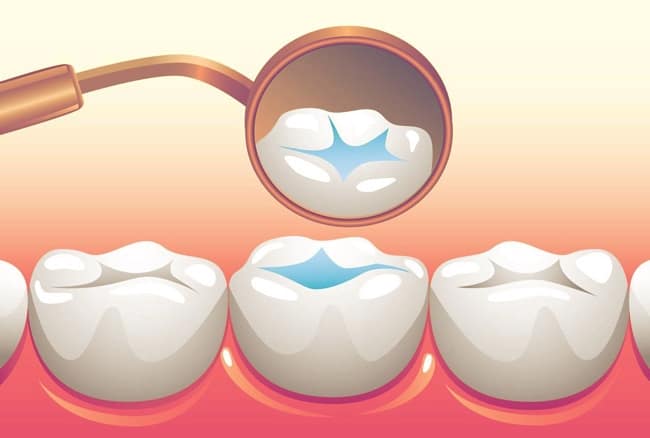
Fissure sealants are a quick coating painted into the grooved chewing surfaces of the back teeth to stop decay starting where a toothbrush can't reach. They suit children as their molars come through, and adults with deep grooves or a higher decay risk. At Gorgeous Smiles in Melbourne CBD, the treatment usually takes only a few minutes per tooth, with no drilling and no injections needed. If you'd like to have your own or your child's grooves checked, you can book an appointment on Exhibition Street.
The deep grooves, called pits and fissures, that run across the chewing surfaces of your molars are often too narrow for a toothbrush bristle to clean properly. Food and bacteria settle in, and tooth decay can take hold before you notice it. A fissure sealant is a thin protective coating that's painted over those grooves and set hard, sealing the surface so plaque and food can't collect in the spots you can't reach.
Dental fissure sealants are preventative rather than a repair. A filling is reactive: it's used once decay has already damaged the tooth and needs to be cleaned out and restored. A sealant works the other way around, protecting a healthy groove before any decay starts. The material is tooth-coloured and safe for use in the mouth, and it bonds to the enamel surface without removing any of the tooth itself.
Sealants are not for every tooth, and an examination is the only way to know whether they'll help in your case. Broadly, they're worth considering for newly erupted back teeth with deep grooves that are still free of decay.
Most fissure sealant treatment is done for children and teenagers, because the timing matters. First permanent molars usually erupt around age six, and second molars around age twelve. A freshly erupted molar with deep grooves is the ideal candidate, since sealing it early protects the surface before decay has a chance to start. Baby molars with particularly deep grooves can sometimes be sealed too, depending on the child's decay risk. Premolars are occasionally treated as well.
Adults are eligible just as much as children, which is something many people don't realise. If you have adult molar teeth with deep grooves that are intact and decay-free, a sealant can give those surfaces extra protection. The same applies if you're prone to cavities or have a history of decay in your back teeth. The one condition is that the groove being sealed has to be healthy. Once decay has started, a sealant isn't the right answer and a filling is needed instead.
The procedure is simple and there's nothing to recover from afterwards. Your dentist first checks the tooth to confirm the groove is healthy and free of decay, because a sealant is only placed over a sound surface. The tooth is then cleaned and dried.
A preparation gel is applied to the enamel surface for a short time, then rinsed off and dried again, which helps the coating bond. The sealant is painted into the grooves and set hard with a curing light, leaving a smooth surface that feels comfortable when you bite. No drilling and no injections are needed. Most people find the appointment straightforward, though comfort and individual responses can vary from one person to the next. Each tooth takes only a few minutes.
Sealants commonly last several years, and one placed early can protect a tooth well into adulthood, though the exact lifespan varies from person to person. They wear gradually with normal use, and a sealant can chip over time.
There's no separate upkeep to think about. Your dentist checks your sealants as part of a routine check up, and if one has worn or chipped it can be reapplied at the same visit. Keeping up with regular brushing and your usual appointments is enough to get the benefits.
The final cost depends mainly on how many teeth are being sealed, so a precise quote is given once the dentist has examined your teeth at your appointment. See our fissure sealants cost page. It's worth weighing against the alternative: sealing a healthy groove now is a smaller piece of treatment than a filling later if decay sets in.


Our Melbourne CBD dental clinic at 121 Exhibition Street is within a:
For detailed information about public transport options, download the PTV app or visit the Public Transport Victoria website.
Sealing a groove before decay starts is one of the more straightforward ways to protect a back tooth. Whether it's the right step for you or your child comes down to an examination by an AHPRA-registered dentist. To have your grooves checked at our Melbourne CBD clinic, book an appointment with Gorgeous Smiles on (03) 9042 0483 or online.
There's no single figure, because it depends on how many teeth are sealed. At Gorgeous Smiles the cost is confirmed once the dentist has examined your teeth.
Yes. Sealing the grooves of decay-prone back teeth is still a standard preventative treatment, and it's recommended for the right teeth at the right time, usually soon after a molar erupts.
Adults can have them as well. If you have deep, decay-free grooves in your back teeth, a sealant can protect those surfaces. The groove has to be healthy for a sealant to be suitable.
No drilling and no injections are involved. Most people find the appointment comfortable, though individual responses can vary. Let your dentist know if anything feels uncomfortable at the time
Commonly several years, though it varies. Your dentist checks it at routine visits and can reapply it if it chips or wears.
No. A sealant seals a healthy groove to keep decay out. If a tooth already has a cavity, a filling is needed instead, which your dentist can discuss at your appointment.
Cover varies by fund and by your level of extras, so it's worth checking your policy for what applies to preventative dental treatment.